

Cat Trees and Scratchers: What Sells Now | JustForPetStore
Cat trees and scratchers earn shelf space in an independent store for one reason: they are bulky, they are behavioral, and customers want to touch them before buying. Future Market Insights values the global cat furniture and scratchers market at $1.6 billion in 2026 and projects $3.09 billion by 2036. Here is how to pick the six units that actually sell.
Why do cat trees and scratchers still sell in physical stores?
Because the two things a customer needs to judge before buying, size and stability, are exactly the two things a product page cannot show. A cat tree that looks right online often arrives too short for the cat or too light to survive a jump, and returns on bulky goods are expensive for everyone.
There is also a channel argument. NielsenIQ data for the 52 weeks ending July 27, 2026 shows pet supplies bought 62% online, with online supply sales up 17.4% and in-store supply sales down 2.5%. Bulk is a large part of why: heavy, awkward cartons are cheap to ship in a container and expensive to ship to a doorstep. That cuts both ways, so treat it as a reason to stock what online cannot deliver well, not as a reason to stock the whole category.
How big is the cat furniture and scratchers market?
Future Market Insights values the cat furniture and scratchers market at $1.50 billion in 2025 and $1.6 billion in 2026, growing at a 6.8% CAGR to $3.09 billion by 2036. Cat trees and towers hold 34.0% of the product segment, wood leads materials at 29.0%, and residential buyers account for 67.0% of demand.
Future Market Insights also describes the category splitting in two: commodity corrugated scratchers that get replaced monthly, and furniture-grade pieces expected to last years. That split is the most useful thing in the report for a small retailer, because the two halves behave completely differently in your store. Corrugated scratchers are a consumable with repeat traffic. Furniture-grade trees are a considered purchase with a long decision and a high ticket.
Grand View Research, in its cat pet accessories outlook, puts the wider cat accessories segment at $2,562.3 million in 2025 and $4,596.7 million by 2033, a 7.6% CAGR, with North America the largest revenue market. Different scope, same direction: cat hard goods are compounding.
Which formats should a small store carry?
Six units is usually enough, split across three jobs.
Two entry pieces under about $40: a corrugated lounge scratcher and a small sisal post. These are the impulse and replacement items, and they are what you reorder most often.
Two mid pieces between $60 and $140: a multi-level tree with one enclosed hide, and a corner unit. These are the units customers ask to see assembled, and they carry your margin.
Two premium pieces above $180: a large tree with replaceable sisal and fabric pads, and a furniture-style unit that reads as decor. You may only sell one a month, but one is often $400 and it changes your average ticket for the week.
One more rule for the entry tier: never buy it on price per unit alone. Corrugated scratchers are sold by the case and priced by the piece, and a case that looks cheap often arrives compressed, dented at the corners, or packed in a carton too large to shelve. Open one case in front of the driver and photograph it before you sign. If a supplier will not accept a claim on damaged corrugated, the cheap case is not cheap, and you will be discounting half of it by the third week.
Add replacement parts to the same order: sisal refill posts, corrugated inserts and replacement pads. The Future Market Insights note about replaceable wear components is the commercial point of the whole category. A customer who comes back for a $12 insert is a customer who comes back.
What makes a cat tree worth the shelf space?
Four tests, applied to the sample before you order a case.
Stability: push it hard at the top. If it rocks on a hard floor, a 15-pound cat will tip it and you will hear about it.
Base footprint: measure it. Customers consistently underestimate how much floor a tree takes, and the returns you get are almost always size mismatches rather than quality complaints.
Replaceable wear surfaces: sisal wrapped posts that can be re-wrapped or swapped, and pads that can be lifted off and washed. A tree with no replaceable parts becomes garbage the day the rope gives out.
Assembly honesty: assemble one in the store. If it takes two people forty minutes and the instructions are diagrams only, budget for assembly as a service or skip it.
How do you price cat trees against online competitors?
Do not try to match the price. Match the outcome. A customer comparing your $129 tree against a $99 listing is also comparing a two-week delivery, a box on the doorstep, and no one to call. Say that out loud on the shelf tag.
Use three price points rather than a smooth ladder. Three points make the decision easy: good, better, and the one that looks like furniture. A continuous ladder from $39 to $299 makes people stall.
Then protect the margin with attachment rather than with price. A tree sold with a replacement insert, a toy and a treat at the point of sale has a lower chance of being price-shopped later, because the customer bought a solution.
How much inventory can a small shop actually afford to hold?
Bulky goods tie up cash and floor space at the same time, which is the reason this category goes wrong. Work from turns, not from margin. If a $200 tree sells once every six weeks, it occupies roughly $200 of cash and about four square feet for 42 days. Compare that with the same money in consumables that turn every two weeks.
A workable starting position for a 1,500 square foot shop is four assembled units on the floor and two boxed in the back, with replacement parts ordered every reorder cycle. More than that and the back room becomes the problem.
Reorder on a calendar rather than on a stockout. Assembled display units are also your inventory, so a bare floor means you sold through and did not notice.
What do customers ask about before they buy?
Four questions, and you should have the answer on the tag.
“Will my cat actually use it?” Answer with height and texture: cats climb to get up and scratch to stretch, so a unit with both a vertical post and a perch covers both behaviors.
“How big is it really?” Put dimensions on the tag, including the base, and put a tape measure on the shelf.
“Is it washable?” Be specific about which parts come off and how they are cleaned.
“Will it match my room?” Neutral fabric and wood tones outsell bright colors in most independent stores, and Future Market Insights notes wood at 29.0% of materials for exactly this reason.
How do you display bulky cat furniture in a small footprint?
Use vertical space, and put the assembled units where a cat owner will walk into them rather than where a shopper will browse past them. An assembled tree in the aisle sells the category; a picture of one on a shelf does not.
Keep one floor unit lived-in. Add a toy hanging from it and a pad on the perch, because an empty tree reads as a piece of furniture and a dressed tree reads as a cat’s.
Put the consumable scratchers on a shelf at knee height, near cat beds and furniture and cat toys. Those two adjacencies are where the add-on sale happens, and they keep the heavy units from owning all your floor.
What should you stock alongside the category?
The repeat business is in the surrounding consumables, not in the tree. Cat owners who buy furniture buy litter, treats and toys on a cycle, and the customer standing next to a $180 tree is in a spending mood.
Build a small cat destination rather than a single rack. Our full cat range covers the everyday items that keep the trip repeatable, and the furniture is what makes the destination memorable.
Where does the demand come from?
From households, not from trends. The American Pet Products Association (APPA) reports that 39% of U.S. households, about 53 million, owned a cat in 2025, up from 37% and about 49 million the year before. APPA puts multi-pet households at 65% in 2025, and projects total U.S. pet industry spending rising from $158 billion in 2025 to $165 billion in 2026.
The caution is on the same page: APPA found 22% of pet owners spent less on their pets in 2025, ten percentage points more than in 2024. Cat ownership is growing, but wallets are being watched, which is why the entry and mid price points matter more than the showpiece.
If you want to test the category without committing to a container, our low-MOQ wholesale program lets you bring in two or three units first, and you can contact us for line sheets and dimensions before you give up any floor space.
Sources: Future Market Insights, Cat Furniture and Scratchers Market (2026-2036); Grand View Research, cat pet accessories market outlook; NielsenIQ, Paws for Thought (52 weeks ending July 27, 2026); American Pet Products Association, 2026 State of the Industry Report.
Ready to stock these ideas? Browse wholesale pet KITs →
Shop these pet categories
Wholesale pricing, no minimum order.
Related wholesale collections
Products mentioned here
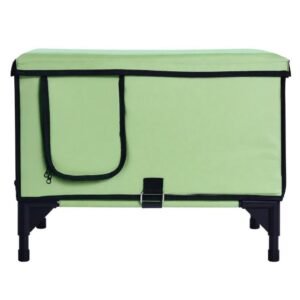 Elevated Heated Outdoor Cat House with 30W Waterproof Heating PadMSRP $128.99Login for wholesale pricing
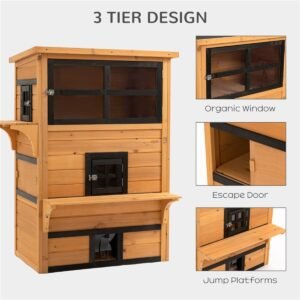 Three-Tier Outdoor Cat Condo with Asphalt Roof and Five Access DoorsMSRP $284.99Login for wholesale pricing
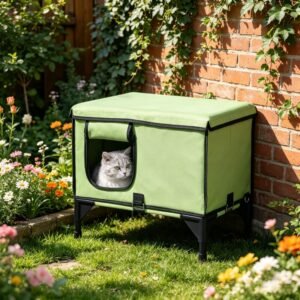 Large Elevated Heated Cat House with Waterproof Pad and Insulated LiningMSRP $124.99Login for wholesale pricing
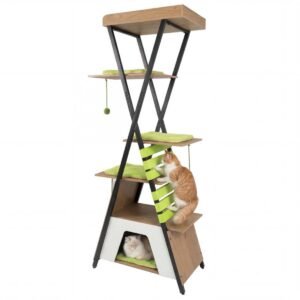 73″ Multi-Level Cat Tree with Condo, Top Perch and Scratching PadMSRP $228.99Login for wholesale pricing
Stock it as a wholesale KIT
Pre-bundled assortments built from this guide’s categories — one PO, one shipment, wholesale pricing.