

Freight Forwarder for Pet Products in 2026 | JustForPetStore
A freight forwarder for pet products is a U.S.-based company that the Federal Maritime Commission licenses to book ocean space, prepare documents and arrange cargo movement on your behalf. Before you pay one, check its license and its bond, because both are public and both are cheap to verify. Here is what the rules require in 2026 and the six questions to ask before you sign anything.
What does an ocean freight forwarder actually do?
Per the Federal Maritime Commission, an ocean freight forwarder is an individual or company located in the United States that arranges cargo movement to an international destination, dispatches shipments from the U.S. via common carriers and books or arranges space for those shipments on behalf of shippers, and prepares and processes the documentation for them.
That is a documentation and booking business, not a trucking business and not a customs business. The forwarder does not take title to your goods, does not normally issue the bill of lading under its own name, and does not file your customs entry unless it also holds a customs broker license. Knowing which of those four things you are buying is most of the work of choosing one.
What is the difference between a freight forwarder and an NVOCC?
Both are ocean transportation intermediaries, or OTIs, and both are regulated under the Shipping Act of 1984 and 46 CFR Part 515. The difference is whose name appears on the bill of lading.
A non-vessel-operating common carrier is a common carrier that holds itself out to provide ocean transportation, issues its own house bill of lading, and does not operate the vessels. To the shipper it looks like a carrier; to the vessel operator it is a shipper. An ocean freight forwarder does not issue a house bill of lading in that capacity.
Practically: if a company issues its own house bill of lading, it is acting as an NVOCC and carries the higher financial responsibility requirement. If it only arranges and documents, it is acting as a forwarder. Many firms do both, and the one you are dealing with should be able to tell you which role it is playing on your shipment.
How do you check that a freight forwarder is licensed?
Three checks, ten minutes, all free.
One: ask for the FMC license number and the OTI bond number. A licensed OTI must hold a license issued under 46 CFR 515.3 and must maintain proof of financial responsibility under 46 CFR Part 515, Subpart C. A company that cannot produce both is not in the business you think it is.
Two: look the name up in the FMC’s public lists. The Commission publishes a list of FMC licensed and bonded OTIs and a separate list of non-compliant NVOCCs. The second list is the one people forget to check.
Three: ask whether the entity quoting you is the same entity that will appear on the invoice. It is common for a sales office abroad to quote under a brand that is not itself licensed in the U.S. trades, with the U.S. side handled by a partner. That is lawful, but you should know who is actually responsible.
How much financial responsibility does an OTI have to carry?
The FMC’s licensing page sets out the amounts, and they are worth knowing because they tell you what the bond is for. The regulation itself, 46 CFR Part 515, is public and worth reading once.
Per 46 CFR 515.21, a U.S. ocean freight forwarder files proof of financial responsibility in the amount of $50,000. A U.S.-based NVOCC files $75,000. A registered, non-U.S.-based NVOCC files $150,000. Industry guidance from the National Customs Brokers and Forwarders Association adds that each unincorporated U.S. branch office performing OTI services adds $10,000 to the bond.
Group bonds are permitted, at the lesser of the per-member requirement or $3,000,000 in aggregate. The bond is not insurance for the OTI. It exists to pay judgments, settlements, reparation orders and penalties owed to people who have claims against the OTI, and it can be terminated on 30 days notice to the Commission. That last point is why you re-check the bond before every new program rather than once a year.
Who files the customs entry and who is the importer of record?
Not the forwarder, unless it separately holds a customs broker license issued by U.S. Customs and Border Protection. An FMC license and an OTI bond do not authorize anyone to file an entry, classify goods, or pay duties on your behalf. Those are separate regimes: OTIs under 46 CFR Part 515, customs brokers under 19 U.S.C. 1641 and 19 CFR Part 111.
You, the buyer, remain the importer of record unless you formally appoint someone else, and reasonable care over classification, valuation and origin stays with you regardless of who types the entry. If a forwarder tells you it will “handle customs,” ask which licensed broker will file and get that name on paper.
The same question applies to the Importer Security Filing and to any FDA prior notice if you are importing regulated products. Ask specifically who files, under whose number, and what happens if they miss the window.
What has to be in writing before you book a shipment?
Six items, and a quote that lacks any of them is not a quote.
Scope of service: forwarder, NVOCC, or both, and whether customs entry is included or excluded.
Charges in a named currency: ocean freight, origin charges, destination charges, and which party pays which under the agreed Incoterms rule.
Transit and free time: the estimated port-to-port days, and the free days at the destination before demurrage and detention start accruing. This is where most first-time importers lose money, and it is almost never in the headline rate.
Cargo insurance: whether it is included, excluded, or offered, and at what value. Carrier liability limits are not insurance.
Document responsibilities: who supplies the commercial invoice and packing list, who files the security filing, and who holds the original bill of lading.
Claims and communication: a named contact, a response time, and a written process if the container is held.
How do you compare two freight quotes properly?
Do not compare the ocean freight line. Compare the landed cost per unit.
Build a single table with the same columns for each quote: freight, origin charges, destination charges, expected demurrage exposure at your realistic pickup speed, insurance, customs broker fee, duties at your classification, and the delivery cost to your door. Divide by units. The quote with the lower freight line is frequently the more expensive one.
One more column belongs in that table: cash. A container paid for sixty days before it sells is sixty days of working capital sitting on the water, and for a single-store operator that is frequently the binding constraint rather than freight cost. Ask each forwarder what deposit is due at booking and when the balance falls due, and put those dates in the comparison. A quote that costs $200 more but is payable on arrival can be the cheaper decision for a shop with one reorder cycle of cash in the bank.
Then adjust for reliability, which is a real cost. A forwarder that answers in four hours and tells you about a roll-over the day it happens is cheaper than one that answers in two days, because the second one converts small problems into storage charges.
What are the red flags that should end the conversation?
It cannot produce an FMC license number and bond number on request.
It appears on the FMC’s non-compliant NVOCC list, or its name differs from the name on the bond.
It asks to be the importer of record without explaining what that means for your liability.
It quotes a single all-in number with no breakdown and no named charges.
It wants full payment before the booking is confirmed, with no written terms.
It will not tell you which customs broker will file the entry.
Any one of these is a reason to keep looking. Two is a reason to walk.
How does this fit a small store’s first container?
Start with the volume you can actually sell, not with the container that looks efficient. A half-empty 40-foot box of slow-moving goods costs more per unit than a full 20-foot box of things you know you can move, once you count the cash tied up and the storage at your end.
Consolidation is the middle path. Groupage services let you buy a few cubic metres on someone else’s container, which is slower and slightly more expensive per unit but requires a fraction of the cash and commitment. It is the right way to test a new supplier.
Then match the freight decision to the assortment. Consumables such as dog care and hygiene lines turn fast enough to justify your own container as your volume grows; bulky or uncertain items should stay on consolidation until you have two reorder cycles of data. Our dog and cat ranges are built for that pattern, and our low-MOQ wholesale program lets you build volume without committing to a full box on the first order. If you want to talk through landed cost on a specific line, contact us and send the product list.
Sources: Federal Maritime Commission, Ocean Transportation Intermediaries and Licensing and Certification pages (46 CFR Part 515, Subpart C; 46 CFR 515.21); 46 CFR Part 515, eCFR; National Customs Brokers and Forwarders Association, guidance on becoming an ocean transportation intermediary.
Ready to stock these ideas? Browse wholesale pet KITs →
Shop these pet categories
Wholesale pricing, no minimum order.
Related wholesale collections
Products mentioned here
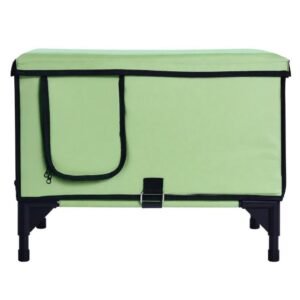 Elevated Heated Outdoor Cat House with 30W Waterproof Heating PadMSRP $128.99Login for wholesale pricing
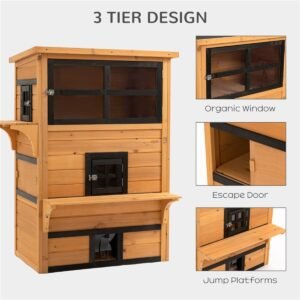 Three-Tier Outdoor Cat Condo with Asphalt Roof and Five Access DoorsMSRP $284.99Login for wholesale pricing
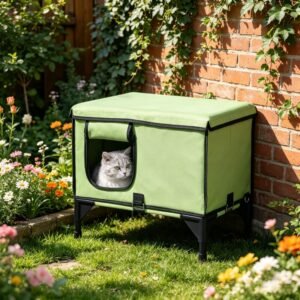 Large Elevated Heated Cat House with Waterproof Pad and Insulated LiningMSRP $124.99Login for wholesale pricing
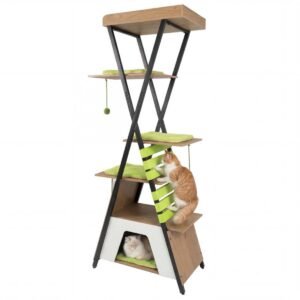 73″ Multi-Level Cat Tree with Condo, Top Perch and Scratching PadMSRP $228.99Login for wholesale pricing
Stock it as a wholesale KIT
Pre-bundled assortments built from this guide’s categories — one PO, one shipment, wholesale pricing.