

OSHA Compliance for Pet Stores: Checklist | JustForPetStore
Most pet stores with ten or fewer employees do not have to keep an OSHA injury log, but every covered employer still has two hard duties: report certain injuries fast, and keep employees free from recognized hazards. If you had more than ten people at any point last year, you must also keep OSHA 300, 300A and 301 records for five years. None of it is difficult; the stores that get cited are the ones that never wrote anything down.
Does OSHA apply to a small pet store?
Yes, and the duty does not switch off because your payroll is small. Section 654(a) of Title 29 places two obligations on every employer: furnish each employee employment and a place of employment which are free from recognized hazards that are causing or are likely to cause death or serious physical harm, and comply with occupational safety and health standards issued under the Act. Employees carry a matching duty to follow the rules that apply to their own conduct.
What changes with size is the paperwork, not the duty. The OSH Act covers most private retail employers, including independent pet stores, whether you run one location or three. A number of states operate their own OSHA-approved job safety and health plan, which must be at least as effective as the federal program, and in those states the state agency enforces equivalent or stricter rules under its own citations.
The practical consequence is simple. There is no headcount below which you are free to ignore hazards, and most of what an inspector asks to see is documentation. The cheapest form of insurance available to an independent store is a single safety folder you can hand over without scrambling.
What does the general duty clause actually require?
It requires you to fix hazards you already know about. The clause in 654(a)(1) is the catch-all: where no specific standard governs a hazard, OSHA cites the general duty to argue that a condition caused or was likely to cause death or serious physical harm. Three elements make that case: the hazard existed, it was recognized by you or by your industry, and a feasible correction existed.
In a pet store, recognized hazards are unglamorous and easy to list during a slow afternoon. A new employee lifting a 40-pound bag of food alone. A customer’s dog loose at the end of an aisle with the handler looking at their phone. A spray bottle decanted into an unlabeled container under the sink. A pallet moved into the rear exit “for one night.” A floor mopped during open hours without a wet-floor sign. Each one is a recognized hazard with a cheap fix, which is exactly what makes a citation frustrating.
Where a specific standard exists, the standard governs instead of the general duty clause. Cleaning chemicals are the clearest example, because the hazard communication rule writes out precisely what you owe your staff.
Do you have to keep an injury log?
Maybe not, and most independent stores genuinely qualify for the exemption. Under 29 CFR 1904.1, if your company had ten or fewer employees at all times during the last calendar year, you do not need to keep OSHA injury and illness records unless OSHA or the Bureau of Labor Statistics tells you in writing that you must. The test uses your peak employment during the prior year, and it counts the entire company rather than one location. Two shops of eight people each therefore do not get the exemption.
There is a second exemption that runs by industry and applies to the individual establishment, based on its classification being listed in Appendix A to Subpart B. Do not assume yours qualifies; check your own code. Even if either exemption applies, you are still required to report severe incidents, because the reporting duty attaches to every covered employer regardless of recordkeeping status.
Which injuries must you report to OSHA, and how fast?
Two clocks, both shorter than most owners expect. Fatality: within eight hours of the death if the death resulted from a work-related incident. In-patient hospitalization of one or more employees, an amputation, or a loss of an eye: within twenty-four hours. You can report by calling the nearest OSHA area office, calling 1-800-321-OSHA (1-800-321-6742), or using the electronic reporting application on the OSHA website.
Timing also runs backwards from the incident. A fatality is reportable only if it occurs within thirty days of the work-related incident; hospitalization, amputation and eye loss are reportable only if they occur within twenty-four hours of it. Observation or diagnostic testing alone is not an in-patient hospitalization. If you learn late that an incident was work-related, the same eight- and twenty-four-hour clocks start when you learn it.
What goes into the log, and how long do you keep it?
Three forms, or their equivalents. The OSHA 300 is the Log of Work-Related Injuries and Illnesses, the 300A is the annual Summary, and the 301 is the Incident Report. You have seven calendar days from receiving information about a recordable case to enter it on the 300 and write the 301. Each establishment expected to operate for a year or longer keeps its own 300 log.
Every year you review the 300, create the summary, have a company executive certify it, and post it. The posting deadline is February 1 of the following year, and it stays up until April 30. Retention is five years following the end of the calendar year the records cover, and during that period you must update the log if a case is discovered late or its classification changes.
What does hazard communication ask for in writing?
A written program, kept at each workplace. Section 1910.1200(e) requires employers to develop, implement and maintain a written hazard communication program describing how labels, forms of warning, safety data sheets, employee information and training will be handled. It must contain a list of the hazardous chemicals known to be present, using a product identifier that cross-references the safety data sheet, and it must describe the methods you use to tell employees about the hazards of non-routine tasks and about chemicals in unlabeled pipes.
The program also has to be reachable. It must be made available on request to employees, their designated representatives and OSHA, and it must explain your workplace labeling system so that a new hire can read it without a translation. One binder behind the counter satisfies this if it is current.
Do your cleaning chemicals need safety data sheets?
Yes, one per hazardous chemical you use, and they must be usable rather than merely present. Section 1910.1200(g) requires that copies be maintained in the workplace and kept readily accessible during each work shift to employees in their work areas. Electronic access is allowed as long as no barrier to immediate employee access is created, which in practice means a logged-out computer in a locked office does not qualify.
Training runs on events, not on a calendar. If a safety data sheet does not arrive with a shipment, you must obtain one as soon as possible. Employees need effective information and training at the time of their initial assignment and whenever a new chemical hazard they have not been trained about enters their work area, covering detection methods, physical and health hazards, protective measures and personal protective equipment, and how to read labels and safety data sheets. Do not remove or deface supplier labels. This rule bites hardest in grooming and shampoo work and in everyday cleaning and hygiene stock.
What belongs in a one-page safety plan?
Six headings are enough: named responsible person, hazard list with a date on each line, animal handling protocol with the personal protective equipment you require, receiving and storage rules, chemical inventory with the location of the safety data sheet binder, and emergency contacts and procedures.
Write the animal line concretely: no employee handles an unfamiliar animal alone, gloves available at the station, no hands in the enclosure during cleaning, and any bite or scratch is documented the same day. Write the storage line concretely too: two-person or cart-assisted movement for anything over 40 pounds, nothing stacked above shoulder height, nothing in front of the rear exit. Bulky goods like crates and kennels are where back injuries and toppled stacks both come from, so give them their own shelf rule. Smaller low-MOQ wholesale case packs also reduce how often anyone lifts the heaviest cartons alone.
How often should you review it, and what should you keep?
Walk it quarterly, rewrite it annually, and revise it immediately after any incident or any new chemical or piece of equipment. Review is not a meeting for its own sake; it is the act that turns a policy into evidence.
Keep three pieces of paper even if you do not keep a 300 log: the signed safety plan with revision dates, the training records for each employee with their initial assignment date, and the dated walk-through notes. In an inspection, contemporaneous records are treated as proof that you looked, and a policy written the week before is transparently not that. If you want a second pair of eyes on your plan before anyone else does, send it over and we will read it against the checklist above.
Sources: 29 U.S.C. 654 (OSH Act duties of employers and employees); 29 CFR Part 1904 (Recording and Reporting Occupational Injuries and Illnesses); 29 CFR 1910.1200 (Hazard Communication).
Ready to stock these ideas? Browse wholesale pet KITs →
Shop these pet categories
Wholesale pricing, no minimum order.
Products mentioned here
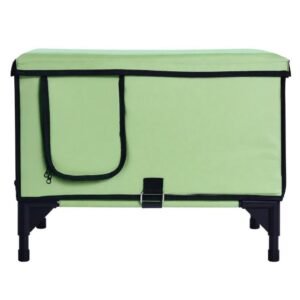 Elevated Heated Outdoor Cat House with 30W Waterproof Heating PadMSRP $128.99Login for wholesale pricing
 Three-Tier Outdoor Cat Condo with Asphalt Roof and Five Access DoorsMSRP $284.99Login for wholesale pricing
 Large Elevated Heated Cat House with Waterproof Pad and Insulated LiningMSRP $124.99Login for wholesale pricing
 73″ Multi-Level Cat Tree with Condo, Top Perch and Scratching PadMSRP $228.99Login for wholesale pricing
Stock it as a wholesale KIT
Pre-bundled assortments built from this guide’s categories — one PO, one shipment, wholesale pricing.