

Pet Product Green Claims: FTC Rules 2026 | JustForPetStore
Pet product green claims are regulated, and the rules apply to you even when the wording comes from your supplier. The Federal Trade Commission’s Green Guides, at 16 CFR Part 260, cover environmental claims in labeling, advertising, and business-to-business transactions, and the Commission can act under Section 5 of the FTC Act if a claim is inconsistent with them. Unqualified words like eco-friendly are the risk.
What are the FTC Green Guides, and do they cover pet products?
The Guides are the Commission’s current views on environmental marketing claims, published at 16 CFR Part 260. They do not confer rights on anyone and they do not bind the FTC or the public, but the Commission can take action under the FTC Act when a marketer makes an environmental claim that is inconsistent with them. The legal hook is Section 5 of the FTC Act, 15 U.S.C. 45, which prohibits deceptive acts or practices.
Scope is where most small sellers across the dog and cat aisles get surprised. The Guides apply to claims about the environmental attributes of a product, package, or service in connection with marketing or sale to individuals, and the text states explicitly that they also apply to business-to-business transactions. They cover labeling, advertising, promotional materials, and all other forms of marketing in any medium, whether a claim is asserted directly or by implication, through words, symbols, logos, depictions, or brand names.
So the answer is yes. A hangtag on a dog bed, a bullet on a product page, a shelf talker, and a line in a wholesale line sheet are all inside the same rule. The Guides also do not preempt federal, state, or local law; complying with a state labeling rule does not by itself protect you from a Commission enforcement action.
Why is “eco-friendly” the riskiest phrase on a package?
Because it is a general environmental benefit claim, and the Guides treat those as nearly impossible to substantiate. Section 260.4 makes it deceptive to misrepresent that a product, package, or service offers a general environmental benefit, and it warns that unqualified general claims are difficult to interpret, likely convey a wide range of meanings, and may convey that the item has no negative environmental impact.
The Commission’s reasoning is practical. Because it is highly unlikely that marketers can substantiate all reasonable interpretations of those claims, marketers should not make unqualified general environmental benefit claims. The Guides go further with a brand-name example: the brand name “Eco-friendly” likely conveys far-reaching benefits and may convey that the product has no negative environmental impact, so using it as a brand name is deceptive.
There is a defensible alternative. Marketers can qualify a general claim with clear and prominent language that limits it to a specific benefit, and they should not imply that a benefit is significant if it is negligible. In practice, “made with 40% post-consumer recycled polyester” is a claim you can defend; “eco-friendly” is not.
What does substantiation actually mean for a claim on a pet product?
It means evidence you already hold, not a promise from the factory. Section 260.2 restates the basic deception standard and then sets the bar: marketers must identify all express and implied claims an advertisement reasonably conveys, and must ensure that all reasonable interpretations are truthful, not misleading, and supported by a reasonable basis before the claims are made. In the environmental context, a reasonable basis often requires competent and reliable scientific evidence.
That phrase has a definition. Competent and reliable scientific evidence consists of tests, analyses, research, or studies conducted and evaluated in an objective manner by qualified persons and generally accepted in the profession to yield accurate and reliable results. The evidence should be sufficient in quality and quantity to substantiate that each claim is true.
Practical translation for a buyer: for every environmental word on your artwork, ask the factory for the test report that supports it, with the lab name, the standard used, the date, and the scope. If the only answer is that “everyone in the industry uses this word,” you do not have substantiation, and if a claim is ever challenged the question will be what you held before printing.
When can a certification or seal go on the packaging?
Seals are not a shortcut around the Guides; they are a claim of their own. Section 260.6 makes it deceptive to misrepresent that a product has been endorsed or certified by an independent third party, and it points to the FTC’s endorsement rules at 16 CFR Part 255. Third-party certification does not eliminate the marketer’s obligation to have substantiation for all claims reasonably communicated by the certification.
The critical test is whether the seal conveys its own basis. The Guides say that using an environmental certification or seal likely conveys a general environmental benefit if the certification does not convey the basis for it, either through the name or some other means. Because general benefit claims are so hard to substantiate, marketers should not use seals that do not convey their basis.
The examples are instructive. A seal awarded by the marketer to its own product is deceptive unless accompanied by clear and prominent language saying so and limiting the benefit. A seal from a trade association is deceptive if the ad does not disclose that the certifier is an industry body. And an independent certifier’s seal can still be deceptive if industry members hold a veto over changes to the standard, because the certification then implies independence it does not have. Ask who owns the standard and who audits against it.
What do the Guides say about compostable and degradable claims?
Compostable claims, at 260.7, require competent and reliable scientific evidence that all materials in the item will break down into usable compost in a safe and timely manner, meaning in approximately the same time as the materials with which it is composted. Qualification is required if the item cannot be composted safely at home, or if the claim misleads consumers about what happens in a landfill. If composting facilities are not available to a substantial majority of consumers or communities where the item is sold, the claim must say so.
Degradable claims, at 260.8, are stricter than most people expect. The section covers degradable, biodegradable, oxo-degradable, oxo-biodegradable, and photodegradable claims together. An unqualified claim requires evidence that the entire item will completely break down and return to nature within a reasonably short period after customary disposal, and it is deceptive for items entering the solid waste stream if they do not completely decompose within one year. Landfills and incinerators do not present conditions where that happens.
For a pet store, this lands hardest on poop bags. A bag that degrades in a soil burial test but ends up in a landfill is the fact pattern the Guides use as a deceptive example.
How do recyclable and recycled content claims differ?
They are two different questions. Recyclable is about what happens after the consumer is finished. Recycled content is about what went into the item.
Under 260.12, a product or package should not be marketed as recyclable unless it can be collected, separated, or otherwise recovered from the waste stream through an established recycling program. Unqualified claims are allowed only when recycling facilities are available to a substantial majority of consumers or communities where the item is sold, and the Guides define substantial majority as at least 60 percent. Below that, the claim must be qualified, either by stating the percentage with access or by using language scaled to how limited access is.
Two further traps sit in the same section. An item made from recyclable material that programs will not accept because of its shape or size should not be marketed as recyclable, and if any component significantly limits the ability to recycle the item, any recyclable claim is deceptive. A mixed-material pet toy with a metal bell and a plastic body is not recyclable just because both materials are theoretically recoverable.
Under 260.13, recycled content means materials recovered or diverted from the waste stream, either pre-consumer during manufacturing or post-consumer after use. Unqualified claims are allowed only if the entire product or package, excluding minor incidental components, is made from recycled material. Partial content must be qualified by percentage by weight. If the source includes pre-consumer material, the marketer needs substantiation that it would otherwise have entered the waste stream.
What about free-of and non-toxic claims on pet goods?
Both are treated as claims about risk, and both can be deceptive even when literally true.
Section 260.9 makes it deceptive to misrepresent that a product is free of, or does not contain or use, a substance. A truthful free-of claim can still be deceptive if the product contains substances that pose the same or similar environmental risks as the one being disclaimed, or if the disclaimed substance has not been associated with the product category. Trace amounts are permitted, but only when three conditions are met: the level is no more than an acknowledged trace contaminant or background level, the presence does not cause the material harm consumers typically associate with that substance, and the substance was not added intentionally.
Section 260.10 treats non-toxic as a safety claim. It likely conveys that a product is non-toxic both for humans and for the environment generally, so marketers must have competent and reliable scientific evidence of both, or qualify the claim clearly and prominently. The Guides’ own example is a cleaning product advertised as essentially non-toxic that poses no risk to humans but is toxic to the environment, which is deceptive.
That example is directly relevant to a pet aisle. A shampoo marketed as non-toxic on the basis of skin safety is making a claim about the environment that nobody has tested. If the word is worth using, get evidence for both halves.
Who carries the risk when a supplier’s claim turns out to be false?
You do, if your name or your brand is on the package. The Guides apply to the marketer, and a retailer or private label owner that puts a claim on its own packaging is the marketer for that claim. The fact that a factory supplied the wording is not a defense; it is a reason to contract around it.
Build three protections into the purchase file. First, a written specification listing every environmental word allowed on the artwork, so the factory cannot add a leaf icon or a “green” line on its own. Second, a document request for test reports, certification scope, and the certifier name, delivered before the pre-production sample is approved. Third, an indemnity clause covering claims arising from labeling the supplier prepared or altered.
Then check the finished product against the approved file. Artwork drift is common: the sample said “recycled polyester” and the shipment says “eco friendly.” Catch it at inspection, not at the shelf.
What should you ask a factory before you approve artwork?
Use the same questions on every private label run, and keep the answers with the tech pack.
Which environmental words will appear on the package, the hangtag, and the insert, and what exact substantiation supports each one? Is the claim about the product, the package, or only part of it, and does the artwork make that clear? Does any seal appear, who owns the standard, and does the seal state its own basis? For recycled content, is it pre-consumer or post-consumer, and what is the percentage by weight? For recyclability, what share of communities where you sell actually accept the item? For compostable, is it home compostable or only industrial?
Finally, ask what happens if you want to remove a word. A supplier that resists removing an unsubstantiated claim is telling you something important about the evidence behind it. If you are building a private label program and want artwork reviewed before tooling, start with a low-MOQ wholesale run so the first mistake is a small one.
Sources: Federal Trade Commission, Guides for the Use of Environmental Marketing Claims, 16 CFR Part 260 (260.1 scope; 260.2 interpretation and substantiation; 260.4 general environmental benefit claims; 260.6 certifications and seals; 260.7 compostable claims; 260.8 degradable claims; 260.9 free-of claims; 260.10 non-toxic claims; 260.12 recyclable claims and the 60 percent threshold; 260.13 recycled content claims); 15 U.S.C. 45 (FTC Act Section 5); 16 CFR Part 255 (Endorsement Guides). General information, not legal advice. Have artwork reviewed by counsel who can read the specific claim and the specific evidence.
Ready to stock these ideas? Browse wholesale pet KITs →
Shop these pet categories
Wholesale pricing, no minimum order.
Related wholesale collections
Products mentioned here
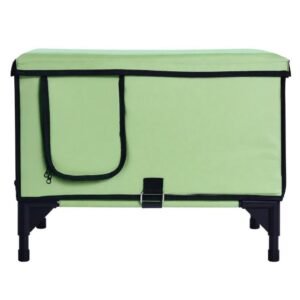 Elevated Heated Outdoor Cat House with 30W Waterproof Heating PadMSRP $128.99Login for wholesale pricing
 Three-Tier Outdoor Cat Condo with Asphalt Roof and Five Access DoorsMSRP $284.99Login for wholesale pricing
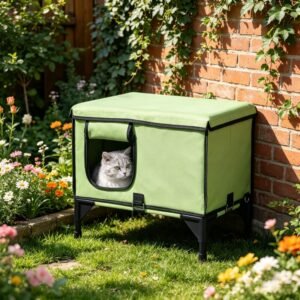 Large Elevated Heated Cat House with Waterproof Pad and Insulated LiningMSRP $124.99Login for wholesale pricing
 73″ Multi-Level Cat Tree with Condo, Top Perch and Scratching PadMSRP $228.99Login for wholesale pricing
Stock it as a wholesale KIT
Pre-bundled assortments built from this guide’s categories — one PO, one shipment, wholesale pricing.